
The Venezuelan Business Dispatch: The Arithmetic of Recovery
Wages, prices, and a central bank under audit. Meanwhile, Airbus checks a new likely regional hub, American Airlines restarts direct flights to the U.S. and Venezuela signs a handful of oil deals.

Venezuela’s reopening has drawn a new audience — investors, advisors, and firms evaluating the country from the outside — that needs more than news coverage. This is a shorter version of a future product by Ecosistema, built for that audience: an analytical briefing on the political, regulatory, and business developments shaping Venezuela’s re-entry into global markets. We’d love your feedback.
SANCTIONS & REGULATORY CONTEXT
The Arithmetic of Recovery: Wages, Prices, and a Central Bank Under Audit
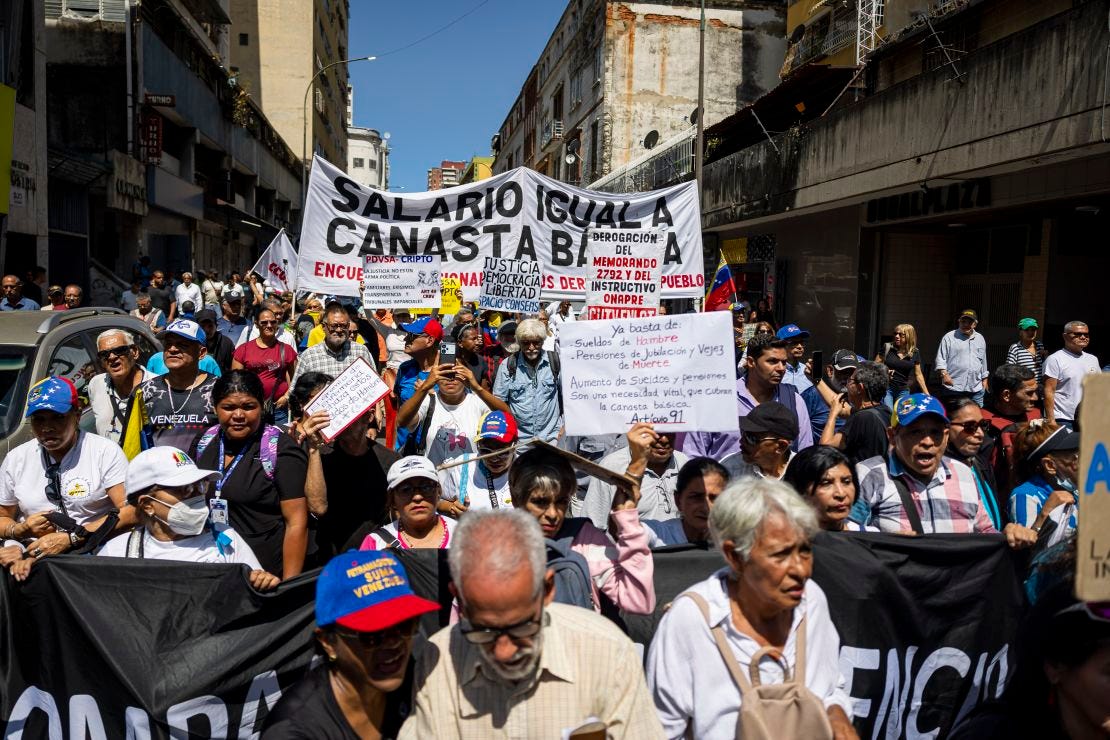
Delcy Rodríguez handed the headline number on May 1: the “ingreso mínimo integral” —Venezuela’s composite income floor, combining base salary and non-wage bonuses— rises to $240 per month, an increase of roughly 25%. Pensions are adjusted 40%, reaching $70. The base salary itself, frozen at 130 bolívares since March 2022, remains untouched — currently worth less than thirty cents. According to Ecoanalítica, a Caracas-based economic research and consulting firm, approximately 70% of Venezuelans earn less than $300 per month.
The structure of the announcement tells the story of the dilemma. Rodríguez’s government is not raising wages; it is raising the envelope around them. The bonification model —in which most compensation flows through non-salary payments that carry no weight in calculating severance, vacation, or profit-sharing— is perpetuated by design. Changing it would require confronting the Ley Orgánica del Trabajo, the 2012 labor law enacted during a petrodollar boom that established unusually generous benefit obligations and has never been updated to reflect the economy that replaced it. For now, the government —while sticking out the possibility of a reform— has chosen not to open that front.
But the structural problem runs deeper than the legal framework. Between 2013 and 2020, Venezuela’s economy contracted by an estimated 75% to 80% — one of the deepest peacetime collapses on record, three to four times worse than the Greek crisis, larger even than the economic losses Ukraine sustained following the Russian invasion. An economy that loses four-fifths of its size doesn’t just produce fewer goods; it loses the companies, the investment, and the workers needed to generate wages in the first place. According to data compiled by FRED —the Federal Reserve Economic Data platform, which aggregates international macroeconomic statistics— formal labor compensation, which historically represented close to half of Venezuela’s national income, has fallen to roughly 10% of GDP. The salary problem is not merely a story of falling purchasing power; it is a story of wage labor ceasing to function as the primary mechanism of income distribution.
The productive base reflects the same collapse. Conindustria, Venezuela’s main industrial federation, estimates that more than 12,000 industrial companies have disappeared in recent decades, while the manufacturing sector operates at well below half its installed capacity. Between 60% and 70% of Venezuelan employment is now informal, according to ENCOVI —the national household living-conditions survey conducted annually by Andrés Bello Catholic University— meaning millions of workers depend on irregular income, small-scale trade, or subsistence activity that cannot sustain stable salaries. More than 7.7 million Venezuelans have emigrated, according to UNHCR and the International Organization for Migration, many of them professionals and skilled workers. “The structural underlying problem is the fall in the country’s productivity, associated with the collapse of its main tradable and export sector,” says economist Asdrúbal Oliveros. Venezuela’s oil production peaked at over 3.4 million barrels per day in the late 1990s, fell below 400,000 bpd by 2020, and has since partially recovered to roughly 800,000–900,000 bpd. The productive capacity that could sustain higher wages has not returned with it.
The fiscal arithmetic further constrains the decision. The Venezuelan state carries a payroll of an estimated 5.3 million active workers plus 5.7 million pensioners —though, as Oliveros warns, “there is a total lack of transparency that makes it very difficult to define what a viable adjustment in the public sector would even look like.” Unofficial figures circulate —roughly 3 million public employees and 5 million pensioners— but the absence of reliable official data prevents any rigorous fiscal debate. As a rough illustration of the stakes: if 6 million people between employees and pensioners received a $50 quarterly increase, the fiscal cost would approach $1.2 billion per year. Economist Jesús Palacios Chacín describes the calibration of the current adjustment precisely: it was designed so that incremental spending does not exceed the additional dollar supply entering the FX market — “to sterilize the effect,” as he puts it. A larger increase would risk a pass-through —wage costs feeding into prices and the exchange rate— that the current macro environment cannot absorb. At the same time, Palacios Chacín projects oil revenues rising up to 70% during the year; further adjustments, he says, are likely.
The private sector’s exposure is more uneven than the headline suggests. Many private salaries already exceed $240 — the more acute risk is salary band compression: as the floor rises, mid-level professionals and senior technical roles are squeezed from below without corresponding adjustments from above. “The operational level usually gets the increase; senior management usually has dollarized packages,” says Antonio Rosamilia, HR director at Farmacias Xana, a Venezuelan pharmacy chain. “The ones caught in the middle are the senior professionals and middle management — and that’s precisely who you can least afford to lose.” His recommendation: widen the distance between the minimum and maximum of each salary band before the floor moves. The sectors best positioned to absorb the adjustment, Palacios Chacín notes, are energy, food, and retail.
Against all of this, the social picture is unsparing. The basic food basket currently runs around $645 per month — a household dependent on the new minimum income needs 2.7 of them to cover food alone. To bridge the gap, the government relies on a parallel structure of direct transfers: the so-called “bonos de guerra” —economic war bonds, a legacy term from the Maduro era’s framing of international sanctions as an economic siege— currently set at $200 for active workers, $168 for retired public employees, and $70 for pension recipients. A new “Bono de Reconocimiento Profesional” — a professional recognition supplement — has been announced for teachers, university professors, healthcare workers, and security personnel. The implicit acknowledgment is clear: the minimum income is not designed to cover the minimum cost of living.
The bank’s new clothes. On a separate front, the Banco Central de Venezuela (BCV) took a step that would have been inconceivable six months ago: it announced the engagement of external auditors —two independent firms, one contracted by the Venezuelan government and one by the U.S. Department of State— to verify the origin, management, and distribution of Venezuela’s foreign assets. Deloitte would be one of these firms, according to independent sources.”The country must have full confidence that resources are going where they need to go,” said BCV president Luis Alberto Pérez González. The dual-auditor structure is designed to provide what no Venezuelan institution currently has the credibility to provide unilaterally: a mutually acceptable accounting of what the state actually holds abroad. Among the assets under scrutiny is Citgo —the Houston-based refining subsidiary of state oil company PDVSA, currently mid-process in a creditor-driven sale estimated at around $10 billion, and actively appealed by Caracas. The BCV also confirmed a new agreement between the Corporación Venezolana de Minería, the state mining company, and New York-based capital firm Heeney Capital, framed as a mechanism to diversify hard currency inflows and reduce the exclusive dependence on oil revenue.
The macro picture, meanwhile, holds a structural contradiction that the BCV is navigating in real time. Monthly inflation closed March at 13.1% — a deceleration from 32.6% in January and 14.6% in February, driven largely by transport (+15.6%), housing services (+15.0%), and leisure and culture (+14.5%). The monthly trend is improving. The annual one is not: Oliveros puts annualized inflation over the past twelve months at 650%, with the first quarter alone accumulating 72%. “The annual rate places us in a hyperinflationary scenario,” he said, calling for an urgent stabilization plan. “The main enemy of wage policy, of consumption recovery, and of corporate growth is, at this moment, this level of inflation.”
BCV president Pérez González is projecting a different trajectory. Speaking before public and private bank representatives on April 24, he cited preliminary GDP figures showing growth during the first quarter of 2026 —extending what the BCV describes as 20 consecutive quarters of economic expansion; a number many independent economists doubt— and said the exchange rate gap between the official and parallel rates has been compressed to 29%. He also confirmed that Venezuela now has a governor and alternate governor at the IMF, and signaled a developing working relationship with the U.S. Federal Reserve.
Bottom line. “A structural solution to the wage problem requires rebuilding productivity,” Oliveros says, “and that is not a quick process.” The wage increase, the dual audit, and the BCV’s optimism are all, in different registers, the same argument — that Venezuela is building the conditions for normalcy. The skeptics’ counterargument is equally coherent: an economy where formal wages represent 10% of GDP, where 70% of workers earn under $300 a month, and where the central bank required external validators to be taken seriously is not a recovering economy — it is a baseline. Both readings are accurate. The question is the velocity of the gap between them.
OIL & DEALS
The week of April 28 – May 1 was the most active deal week Venezuela has seen in a generation. On Thursday morning, Jarrod Agen — deputy assistant to the president and executive director of the National Energy Dominance Council, Trump’s interagency body for energy strategy — stepped off the inaugural American Airlines flight from Miami. By evening, the lobby of the JW Marriott in Caracas was, in the words of the Wall Street Journal, filled with “Spanish spoken with a Texas twang” — engineers, lawyers, and emissaries from the U.S. oil industry pitching plans to revive the country’s rundown fields.
The two American signatories. At Miraflores Palace, PDVSA signed agreements with two U.S. firms: Hunt Overseas Oil Company — the international arm of Texas-based Hunt Oil, one of the country’s oldest independent operators — and Crossover Energy, a smaller Orinoco-focused independent. Both will operate in the Orinoco Belt, Venezuela’s primary heavy and extra-heavy crude province and the foundation of its world-record reserves. A third firm, HKN Energy, also signed a memorandum of understanding. The combined investment is expected to exceed $2 billion, structured through joint ventures under a shared-benefit model. PDVSA also signed a term sheet with Italy’s Eni for activities in the Junín 5 area of the Orinoco Belt. Hydrocarbons minister Paula Henao reported that national oil production has reached 1.208 million barrels per day. Agen framed the aviation and energy openings as inseparable: “How do you get the employees down here?” he said, noting that direct flights create the commercial corridor that investment requires.
BP signs in Caracas. Two days earlier, on April 29, British oil company BP signed a memorandum of understanding at Miraflores covering development of the Cocuina-Manakin offshore gas field —a deposit that straddles Venezuela’s maritime border with Trinidad and Tobago— plus new exploration rights in the adjacent Loran area. BP also confirmed the opening of a new Caracas office. The Cocuina-Manakin field is particularly significant: its development is linked to Shell’s Manatee operations on the Trinidadian side, positioning the cross-border deposit as a potential foundation for LNG export infrastructure.
Exxon’s reversal. On the same day the American Airlines flight landed in Caracas, ExxonMobil CEO Darren Woods told analysts on a Q1 2026 earnings call that Venezuela is “a huge resource that’s now opened up more freely to the world” — adding, simply: “I feel positive about what’s happening, the opportunity there.” The shift is notable. In January, Woods had told President Trump at the White House that Venezuela was “uninvestable.” Technical teams from ExxonMobil have since visited the country to assess Cerro Negro, the heavy oil project the company operated before nationalization in 2007.
Mercuria and Heeney Capital close commodity deals. On May 1, Mercuria Energy Group —one of the world’s largest privately held commodity trading firms, headquartered in Geneva— announced that it had secured, in partnership with New York-based private mining equity firm Heeney Capital, strategic offtake agreements for Venezuelan bulk commodities and gold projects. The deals, advanced alongside Agen’s delegation, are expected to unlock approximately $2.2 billion in annual mineral export value. Mercuria and Heeney are also pursuing additional opportunities in aluminum, nickel, and ferrous products that could represent a further $3 billion annually. The transaction was signed at Miraflores Palace, with James Gilbert, a managing director at Mercuria, in attendance.
The SPAC play on Maha. On April 28, Blue Water Acquisition Corp. IV —a publicly listed special purpose acquisition company, or SPAC, a blank-check vehicle designed to take private companies public through a merger— announced a letter of intent to acquire substantially all of the subsidiaries of Maha Capital AB, a Stockholm-based company with Brazilian senior management. Maha’s principal Venezuelan asset is a 40% stake in PetroUrdaneta, a joint venture with PDVSA operating in the Lake Maracaibo region. The deal values Maha equity at approximately $490 million.
SECTOR FOCUS
The Air Corridor Opens
On April 30, American Airlines subsidiary Envoy Air operated the first U.S. commercial flight to Caracas in more than seven years — a daily Miami–Caracas service on a 76-seat Embraer 175 regional jet, dual-class, with Wi-Fi sponsored by AT&T. Initial economy fares launched above $800 one-way; a second daily frequency is planned for late May, with larger mainline aircraft expected to follow. American had been the dominant U.S. carrier in Venezuela before suspending service in 2019 — at its peak, it flew daily to Caracas from Miami and weekly to Dallas, New York, and San Juan.
Venezuelan carrier Laser Airlines launched its own Caracas–Miami flights on May 1 — with a structural asterisk. Because the U.S. Federal Aviation Administration classifies Venezuela as an IASA Category 2 country — meaning it does not meet minimum international aviation safety standards — Venezuelan carriers are currently barred from operating their own aircraft to the United States directly. Laser’s workaround: a wet-lease arrangement with U.S. carrier Global X, which will operate Airbus A320s under Laser’s commercial branding. Global X is the same carrier that operates the bulk of ICE deportation flights — including direct services to El Salvador’s Cecot prison. For passengers, the arrangement means lower fares.
Panama’s Copa Airlines —which never fully abandoned Venezuela and now operates 19 weekly frequencies between Panama City and Caracas— is quietly building the most comprehensive U.S. connectivity network of any carrier operating out of the country. Through its Hub of the Americas at Tocumen International Airport, Copa now connects five Venezuelan cities (Caracas, Maracaibo, Valencia, and Barquisimeto from May 4; Barcelona from June) to 17 U.S. destinations in a single connection: the equivalent of a full North American network, accessed through a single Panama layover.
Demand for additional U.S. routes is unlikely to plateau any time soon: the 1.2 million Venezuelans living in the United States —concentrated in South Florida but extending across Texas, the Northeast and beyond— represent a permanent VFR base, while the commercial, financial and educational ties that once made Venezuela a top-seven source of tourist arrivals to the U.S. in the late 1990s, and sustained a significant flow of Venezuelan students into Boston-area universities well into the 2010s, suggest a latent demand that direct connectivity alone will begin to unlock.
Airbus sees a hub. At the Wings of Change Americas aviation conference, airlines flagged Caracas as a potential regional hub — and Airbus backed the idea. Arturo Barreira, Airbus president for the Americas, described Venezuela as “an exceptional aviation market,” citing the country’s historical role: until the 1990s, major carriers connected Venezuela to South America, the Caribbean, North America, and Europe. The two decades since represent one of the most dramatic aviation contractions on the continent. “While globally traffic has multiplied, in Venezuela it has been reduced three to four times in the last 20 years,” Barreira said. “It is a market with very important underlying potential.” His geographic case for Maiquetía as a hub is straightforward: “Venezuela is at the center of the Americas. With an A320 you can serve both Montreal and Buenos Aires. For that, it’s perfect.”
Barreira’s aircraft thesis is specific: regional routes built around the A320neo and A321neo airplanes; major long-haul markets —the United States, Spain— requiring the A330-900 and A350 combination. He noted the A350 can even connect Caracas to Beirut, a route that would serve one of the largest Lebanese diaspora communities in the Americas. The diaspora angle, he argued, will generate substantial VFR — “Visit Friends and Relatives” — demand across the U.S., Spain, Italy, France, and even Lebanon. The caveat is structural: Venezuela currently operates the oldest commercial fleet in the hemisphere, with an average aircraft age exceeding 30 years, much of it narrowbody jets with accumulated cycles approaching the limits of useful life. Fleet renewal is not a near-term prospect — “the conditions have not yet been given for many financiers to put assets in the country,” Barreira acknowledged — but he added: “Without a doubt it will be a market we are waiting for. What we have seen since the beginning of the year confirms it.” The comparison he offered for Venezuela’s potential trajectory: Colombia, which rebuilt its aviation sector from near-collapse into one of South America’s most competitive markets over roughly two decades.
Meet the New Venezuelan Consumer
The most comprehensive consumer psychographic study conducted in Venezuela in years was presented in late March by economists Asdrúbal Oliveros and Jesús Palacios Chacín, consultant Alejandro Guzmán, and BAM Consulting, a small marketing firm led by Isabela Hernández — 1,000 responses across the country, crossing variables of value, purchasing behavior, geography, and generation. The portrait that emerges is of a consumer the crisis transformed but did not destroy.
What they value. Roughly 80% of respondents research before spending — through websites, social networks, acquaintances, or micro-influencers. Even in the Poor Urban stratum, the figure stays above 70%. The improvised purchase has lost ground. That information arrives paired with a tight budget, and the combination produces specific behaviors. Brand loyalty follows income: as earnings rise, so does consistency in preferring known brands. In the poorest strata, up to 15% say they “never” follow brand preference. When the money reaches, the trusted brand wins; when it doesn’t, whatever is available wins. Comfort as a purchasing driver is similarly stratified: 70% of the upper stratum says they “always” choose what makes them most comfortable — the highest figure across the scale.
The aspiration inversion. Two findings run counter to intuition. It is the lower strata — Poor Urban (36%) and Popular Middle (34%) — who most frequently choose products that make them look successful or improve their social image, outpacing the upper stratum (26%). Aspiration intensifies where the wallet is thinnest. Beauty spending, Oliveros was emphatic, is the category the crisis never fully broke. What changes in a downturn is the brand, not the habit — beauty fulfills an emotional and social function that transcends the product. In all strata, around 20% invest consistently in personal image; in the upper stratum, that rises to 30%. Education is similarly resilient: regardless of income level, investment in training and self-improvement appears as a central aspiration across all cohorts — one of the few constants the crisis did not erode.
The consumer who is coming. Oliveros provided the macro frame: approximately 2.5 million Venezuelans will move up from the poorest strata over the next year. Add the estimated 11% of the diaspora — around 800,000 people — planning to return, according to NGO Venezuelan Diaspora Observatory. Combined: roughly 3.3 million new or upgraded consumers entering the market. “What will come back when purchasing power recovers is in the Venezuelan DNA,” Oliveros said. Pre-crisis studies documented a consumer who disliked walking between stores and preferred buying everything in one place. Today, the consumer comparison-shops out of necessity. That is not a new person — it is the same person under different constraints.
Oliveros’ recommendations are precise: design value propositions that reduce perceived risk, not just sell attributes — sell certainty of functionality. Make pricing a strategic tool, not a static exercise; in an impoverished market, price errors exclude entire segments. And abandon income-based segmentation as the primary lens: the average Venezuelan consumer already researches, already distinguishes, already decides — with a limited budget. The brands that understand that will be positioned to capture the recovery. The ones that assume their budget defines their ambition will not.
Also worth noting. Months before the Oliveros and BAM study, market research firm Atenas Grupo Consultor presented its own market study at a Caracas sector forum that arrives at a compatible —and in some ways starker— conclusion. Venezuela, Atenas argues, is not one market but three overlapping ones: 64% of the population operates at Nicaragua-equivalent income levels (averaging $239 per month); 29% resembles Colombia ($583 per month); and only 7% reaches Costa Rica-equivalent purchasing power ($1,383 per month). Three Venezuelas sharing the same shelf, reading the same price tag from entirely different financial realities.
One structural shift Atenas flags that deserves attention on its own: private-label products —store brands like Farmatodo‘s own-label lines or Gama‘s house-brand goods— now represent a market estimated at $65 million, up 40% year-on-year, with the number of private-label categories growing 12%. In their first weeks on shelf, a private-label product sells three times more than an equivalent commercial brand; by the end of the first month, four times more. 88% of consumers identify at least one pharmacy private-label, and 81% find it trustworthy in personal care. The private label is no longer a discount fallback — it is a category of its own, and one that incumbent brands are underestimating at their own cost.
MARKET SNAPSHOT
Caracas Stock Exchange · April 20–30, 2026
The IBC —the Caracas Stock Exchange’s main index— ended the two-week period at 5,709.10 points, down from 5,859.72 at the open of April 20, a modest pullback of roughly 2.6% over ten trading sessions. Year-to-date, the index is still up approximately 174% — a figure that looks dramatic on paper but is heavily distorted by bolívar depreciation and best read as a nominal gauge of domestic sentiment rather than real returns. Total volume across both weeks reached approximately Bs 15.3 billion, the bulk of it concentrated in financing certificates rather than equities — a reminder that the exchange functions less as a capital market in the conventional sense than as a structured venue for short-term corporate financing.
What traded. Banco Nacional de Crédito (BNC) led equity volume in both weeks by a wide margin, followed by Banco Provincial, Banco de Venezuela, and Mercantil Servicios Financieros — banking stocks accounting for the majority of the top ten in both periods. The pattern is consistent with prior weeks: in a market where foreign portfolio access remains effectively nonexistent and the investable universe is narrow, financial sector names absorb the bulk of available liquidity. CANTV —Venezuela’s state-owned telecommunications company, partially privatized— appeared in both top tens, a signal of renewed interest in infrastructure-adjacent plays.
Ron Santa Teresa’s offering. The most structurally significant event of the fortnight was Ron Santa Teresa completing the first round of a public offering of Class B shares — the country’s flagship rum producer tapping the exchange as a capital-raising venue. The operation reached Bs 565 million in total volume, placing 53% of the offered shares (approximately 1.53 million). It is a small transaction by any international standard, but its symbolic weight is considerable: a well-known Venezuelan consumer brand using the local exchange to raise growth capital is precisely the kind of activity the market needs to attract if it is to evolve beyond a financing-certificate venue.
What moved. In the week of April 20–24 — which coincided with the Chevron deal, the Repsol announcement, and the LG57 license — Clabe Capital B led gainers at +19.90%, followed by Fondo Petrolia B (+12.68%), the BVC-listed investment vehicle that finances oil service contractors and suppliers. Fábrica Nacional de Cementos rose 7.33%, continuing the rally linked to restructuring expectations tied to the Rodríguez government’s announced audit of state-owned enterprises. Mercantil Servicios Financieros A added 6.64%. The second week was quieter across the board, with the index giving back some of those gains as the deal-week enthusiasm settled.
What it means. The market absorbed a dense sequence of signals —sanctions relief, major oil deals, aviation reopening, multilateral reengagement— and nudged slightly lower rather than surging further. That is arguably a sign of maturity in domestic sentiment: the easy re-rating has already happened, and incremental news is being discounted more carefully. The structural constraints remain unchanged: thin liquidity, no international settlement mechanism, a bolívar-denominated trading floor with no pathway for foreign capital— and the exchange remains, as ever, less a barometer of Venezuela’s economy than of what a small group of domestic investors believes that economy will become.
THE LONG READ
Venezuela 2040, According to EY’s Summit: Jack-Of-All-Trades
“Don’t ask what Venezuela’s role will be in 2030 — 2030 is already here, that’s three years away,” said Micky Malka, head of venture capital firm Ribbit Capital —early backer of Coinbase, Nubank, and Robinhood— speaking via video from Palo Alto. “Ask what Venezuela’s role will be in 2040. Are we a country that exports raw energy? A refiner? Or a services economy?” He paused, then reached for a very Venezuelan word: todero — jack-of-all-trades. A Venezuelan term for someone who does everything, fixes everything, figures it out. It was the most honest possible frame for the InnovEYtion Summit 2026, the second edition of EY Venezuela‘s technology and innovation conference — held at Caracas Campus, the former headquarters of Procter & Gamble, now repurposed as something between a coworking space and a symbolic statement about what comes next.
The event drew entrepreneurs, startup founders, corporate executives, and international speakers across two packed days. Adriana Cisneros, CEO of the Cisneros Group, appeared on video from Miami to announce she was packing to return to Venezuela. Alberto Afiuni, EY Venezuela’s country managing partner, asked whether Wave Tech — a tech startup coworking hub operating inside Caracas Campus — might one day connect with Ruta N in Medellín, or with Silicon Valley. “This has nothing to envy Silicon Valley,” said Alex Gómez, Innovation Lead at accelerator Innoven, at a private Demo Day for ten startups. “Silicon Valley is a state of mind.”
And the ten startups that presented at the Demo Day —young founders, occasionally dressed in the tech bro uniform of the American coasts, more often not— made a grounded argument: that Venezuela’s structural dysfunctions have become, paradoxically, a product specification. Every startup in the room was solving a friction so specific to this economy that it would be nearly invisible anywhere else.
Fina, led by Enrique Rivas, targets small commerce — where Excel and manual processes still dominate — with an integrated platform for inventory, sales, and finance. It already counts 3,500 clients. MotoGo, from Oliver Laufer, runs a motorcycle subscription model for delivery workers and urban laborers, eliminating the barrier of upfront ownership in a country where mobility and income are directly synonymous; 140 active clients, 27,000 on the waiting list, and a projected addressable market of $4.8 billion tied to the 2 million motorcycles already in circulation. Rial, presented by Rafael Graziani, consolidates bolívar, dollar, and crypto accounts through a single AI-organized interface — a product that exists because millions of Venezuelans manage three currencies simultaneously as a matter of daily survival. More than 3,000 daily active users. Quoota, led by Carlos Guruceaga, offers payroll-backed microcredit for workers without access to formal financing — already connected to 330 companies and 32,000 employees, including PepsiCo, Coca-Cola, Santa Teresa, and Farmatodo.
The pattern across all ten is consistent: not abstract disruption, but infrastructure built on top of a country that still operates, in many respects, at half capacity. The banking panel at the Summit made this explicit. Fernando Alonso of BBVA framed the macro challenge as doubling GDP in five years. Jorge Nogueroles of BNC brought it back to earth: credit in Venezuela currently runs at 2–3% of GDP, against pre-crisis levels approaching 40%. There is no credit bureau. The legal framework for cybersecurity is outdated. The goal, as Juan Carlos Dao of Bancaribe summarized it, is a 24/7 bank with real intermediation capacity — which, in Venezuela’s current context, is not a modest ambition. It is nearly starting from scratch.
The other economy. Beyond the startups, the Summit surfaced a harder conversation about what Venezuela’s non-oil economy actually consists of — and what it could. According to Inclusion Consulting Group (ICG), the consultancy led in part by former Fedecámaras president Jorge Roig, Venezuela went from 580,000 companies a decade ago to approximately 480,000 today. Of those, 70% operate in commerce and services; only 6% in manufacturing. Yet among the top 100 companies ranked by the Venezuelan-American Chamber of Commerce (VenAmCham), 20% are manufacturers. The implication Roig draws: manufacturing generates employment and productivity in ways that services cannot, and it is being systematically underbuilt.
The geography of economic activity reinforces the point. According to ICG, 80% of Venezuelan companies are distributed across 10 cities; 56% across just five. The diversification challenge is not only sectoral — it is spatial. And it collides with a deeper structural gap: Venezuela has too many lawyers, Roig said, and too few genetic engineers, data scientists, and AI specialists.
The export bottleneck is equally concrete. Andrés Chumaceiro of Ron Santa Teresa noted that exporting from Venezuela currently takes 70 days and requires approval from 14 government entities. In Panama, the equivalent process takes one week. Pedro Luis Angarita, president of Farmatodo, offered the inverse of that friction as a competitive signal: the chain’s delivery service is already faster than equivalent services in the United States. “Imagine that in a Venezuela with higher purchasing power.”
What the InnovEYtion Summit demonstrated is that the conversation about what comes after oil is no longer speculative — it is operational. Founders are building on it, banks are being redesigned around it, foreign executives are flying in to evaluate it. Whether the scaffolding holds long enough for the structure to take shape is, as always in Venezuela, the open question. But the todero impulse —the instinct to figure it out, to do what’s needed with what’s available— was visible in every startup pitch, every panel, every conversation in the Plaza Central of Caracas Campus. It is not a plan. It might be enough to start with.